Frequently Asked Questions
The most-asked questions about russian regions.
What exactly does 'Russian regions' refer to in this encyclopedia?
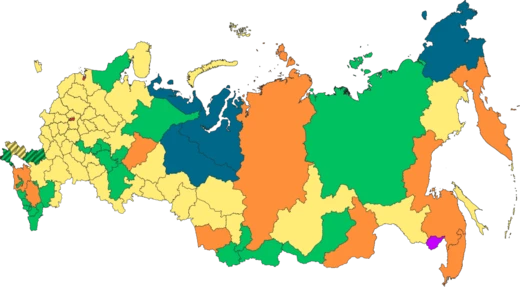
It refers to the 89 federal subjects that collectively form the Russian Federation, each with its own name, capital (or administrative center), and a degree of self-governance defined by the federal constitution. Think of them as the top-level building blocks of the country's administrative map.
What kinds of federal subjects exist, and how do they differ from one another?
The subjects fall into several categories: republics (which may have their own constitutions and official languages), oblasts (provinces), krais (territories), autonomous okrugs and oblasts (ethnic enclaves), and three federal cities (Moscow, Saint Petersburg, Sevastopol). The main distinctions lie in their historical origins, level of legislative autonomy, and whether a specific ethnic group is constitutionally recognized within them.
Who are the key political figures associated with Russian regions?
Each subject is headed by a governor (or, in republics, a head of the republic) who is either elected locally or appointed in coordination with the federal government. Above them sits the federal President, who can dismiss regional leaders and appoint plenipotentiary representatives to oversee federal-district compliance.
Where should a complete beginner start when exploring Russian regions?
A good entry point is to first learn the seven federal districts (Central, Northwestern, Southern, North Caucasian, Volga, Ural, Siberian, and Far Eastern) as a geographic scaffold, then dive into one or two subjects per district to build a mental map. From there, comparing a republic like Tatarstan with a simple oblast like Kirov Oblast clarifies how autonomy levels vary.
How much real power do regional governments hold over local affairs?
In practice, regions manage education, healthcare, local infrastructure, and land use, but fiscal policy, defense, foreign affairs, and the judicial system remain firmly under Moscow's control. The balance has shifted over the decades, and since the 2000s the trend has leaned toward greater central oversight of budgetary and legislative matters.
What are federal districts, and how do they relate to the 89 subjects?
Federal districts are groupings of subjects created for administrative coordination rather than as a separate tier of government; there are eight of them, each headed by a presidential envoy. They do not replace the subjects themselves but serve as an organizational layer through which the Kremlin communicates policy and monitors compliance.
Which regions are most frequently singled out as 'unique' or atypical?
The three federal cities stand out because they function simultaneously as a subject and a municipal entity with no surrounding rural area. The North Caucasian republics are often noted for their distinct legal and cultural frameworks, while the Far Eastern subjects are highlighted for their vast area, sparse population, and special economic incentives.
How has the number and shape of Russian regions changed since the Soviet era?
The current 89-subject structure largely dates to the 1990s, when the USSR dissolved and the Russian SFSR inherited the Soviet union-republic-oblast layout. Since then, a handful of small okrugs have been merged into neighboring krais or oblasts, and two new subjects (Krasnodar Krai's reorganization and the creation of Sevastopol in 2014) have altered the count.
Do residents of different regions have different legal rights or obligations?
Citizenship is uniform at the federal level, so voting, taxation, and criminal law apply equally everywhere. However, republics may grant additional protections to indigenous languages and cultures, and certain regions offer preferential tax regimes or residency incentives to attract businesses and settlers.
What are some notable historical or political moments tied to specific regions?
The 1991–1994 'power struggles' saw several republics and oblasts briefly challenge Moscow's authority over budget and border issues, most dramatically in Tatarstan and Bashkortostan. More recently, the 2014 incorporation of Crimea and the establishment of Sevastopol as a separate federal city remains one of the most consequential changes to the regional map in the post-Soviet period.