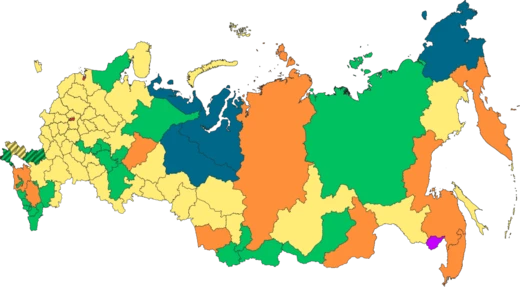
Yaroslavl Oblast
A historic Russian region with early medieval roots and industrial growth.

Yaroslavl Oblast is a federal subject of Russia (an oblast) located in the Central Federal District. It is surrounded by Tver, Moscow, Ivanovo, Vladimir, Kostroma, and Vologda oblasts, giving it proximity to Moscow and Saint Petersburg. The city of Yaroslavl serves as the administrative center and is served by major highways, railroads, and waterways. The oblast's population was 1,272,468 as of the 2010 Census.
- type
- Federal subject of Russia (oblast)
- location
- Central Federal District, Russia
- administrative_center
- Yaroslavl
- population_2010
- 1,272,468
- climate
- Temperate continental
- major_river
- Volga River
- major_reservoir
- Rybinsk Reservoir
Lore & Background
People first settled in the area during the Paleolithic Era at the end of the last glacial period. The Fatyanovo–Balanovo culture introduced agriculture by the beginning of the 2nd millennium BC. The earliest historically documented inhabitants were the Volga Finnic Merya people, who blended with Balto-Slavic tribes from the 9th to 10th centuries AD into the Kievan Rus' cultural community. Rostov, the oldest city in the region, was first mentioned in 862 AD and became a main political and religious center of Northeast Kievan Rus'. Notable Rurikid princes included St. Boris and Yaroslav the Wise, founder of Yaroslavl.
Reader's Guide
Yaroslavl Oblast holds significance as part of the core of Russian lands since the early Middle Ages. Its cities—Rostov, Yaroslavl, Pereslavl, Uglich—were central to the rise of the Vladimir-Suzdal Principality and later the Moscow-centered state. The region endured the Mongol-Tatar invasion in 1238, with battles at Pereslavl and the Sit River. During the Time of Troubles, it was raided by forces of False Dmitry II and Polish-Lithuanian allies. In the 16th century, Yaroslavl became a major trade center connecting Central Russia with the Volga and Arkhangelsk. The 18th century saw the establishment of the first public elementary school in Yaroslavl (1718) and the first permanent theater in Russia (1750). The Rybinsk Reservoir, filled between 1941 and 1947, flooded the town of Mologa and hundreds of villages, relocating about 150,000 people. The oblast's mineral resources are limited to construction materials and peat, with some mineral water springs.
Did You Know?
- The Rybinsk Reservoir, filled between 1941 and 1947, is one of the largest in Europe and flooded the former town of Mologa and hundreds of villages.
- The earliest historically documented inhabitants of the region were the Volga Finnic Merya people.
- In 1750, young Yaroslavl socialite Fyodor Volkov organized the first permanent theater in Russia.
- The oblast's climate is temperate continental, with the coldest month January averaging −8.2 °C and the warmest July averaging +18.9 °C.
Geography & Living Landscape
The oblast sits within a temperate continental climate where four distinct seasons govern the year. January is the coldest month, averaging around minus eight degrees Celsius, while July peaks near nineteen degrees. Most rainfall arrives as brief showers during the warmer half of the year. The natural cover has transformed over the centuries: dense conifer woodland of fir and pine that once dominated the landscape has largely been harvested, giving way to second-growth birch and aspen forests, crop fields, and broad swamps. Large mammals—bears, wolves, foxes, moose, wild boar—survive in reduced numbers, and the skies teem with nesting wild birds. In towns, residents share space with pigeons, jackdaws, hooded crows, rooks, house sparrows, and great tits. The Volga River threads through the region, its course shaped by major hydroelectric dams at Uglich and Rybinsk. The Rybinsk Reservoir, filled between 1941 and 1947, ranks among Europe's largest artificial water bodies. Its creation submerged the town of Mologa and several hundred villages, displacing roughly 150,000 people across three oblasts. Mineral resources remain modest, limited to sand, gravel, clay, peat, and natural mineral-water springs.
The Rostov-Suzdal Heritage
Rostov, first recorded in 862 AD, stands as the oldest city in the region and long served as the political and religious heart of Northeast Kievan Rus'. The Rostov eparchy, established in 991, was among the earliest ecclesiastical jurisdictions in Russia. Rurikid princes held their fiefs here, including St. Boris and Yaroslav the Wise, who founded the city that would give the oblast its name. After Yaroslav's death, his son Vsevolod inherited Rostov and the broader North-Eastern lands in 1054, governing them through viceregents from Pereyaslavl. In 1071 the smerd rebellion, led by powerful Yaroslavl magi, ended with the murder of Bishop Leontius of Rostov. The early twelfth century brought Yuri Dolgoruky, who received Rostov as his principality but shifted his capital to Suzdal in 1125. During his reign he founded Pereslavl, Uglich, and Romanov. His son Andrey Bogolyubsky, taking power in 1157, renounced claims to Kiev and Pereyaslavl, proclaimed himself Grand Prince, and established Vladimir as his capital—marking the birth of the Vladimir-Suzdal Principality. After Vsevolod the Big Nest died in 1212, the North-East fractured. Rostov, Yaroslavl, Pereslavl, and Uglich each became independent principalities while still acknowledging the formal suzerainty of the Grand Princes of Vladimir.
Mongol Invasion & the Rise of Moscow
In the winter of 1238, Mongol-Tatar armies struck Northeastern Rus' with devastating force. Pereslavl resisted for five days before falling, losing most of its population, while Rostov and Uglich surrendered without a fight. Grand Prince Yuri II of Vladimir was killed at the Battle of the Sit River, along with his nephews, the princes of Rostov and Yaroslavl. The Vladimir-Suzdal domain was thereafter compelled to pay tribute and submit to the conquerors' political will. The thirteenth and fourteenth centuries saw the Rostov and Yaroslavl principalities continue to fragment, making them vulnerable to the House of Moscow. In 1302, Ivan of Pereslavl bequeathed his lands to Daniel of Moscow. In 1328, Ivan I purchased the Uglich principality. From 1332 onward, Muscovite rulers acquired portions of the Rostov Principality incrementally, completing its subjugation by the mid-fifteenth century. Yet the region's loyalty to a unified Russian cause endured: in 1380, soldiers from Rostov and Yaroslavl joined Dmitry Donskoy's allied army at the Battle of Kulikovo. Ivan III the Great completed the consolidation of these territories, compelling the last prince of Yaroslavl, Alexander Bryukhaty, to sell his possessions in 1463, and purchasing the remaining Rostov territories in 1474.
Strategic Position & Trade Heritage
Yaroslavl Oblast occupies a privileged position within Russia's Central Federal District, bordered by six neighboring oblasts—Tver and Moscow to the west, Ivanovo and Kostroma to the east, Vladimir to the south, and Vologda to the north. This placement grants the region close proximity to both Moscow and Saint Petersburg, the country's two largest cities. The administrative center, the city of Yaroslavl, is served by major highways, railroads, and waterways, making it a natural crossroads for overland and river traffic. As of the 2010 Census, the oblast was home to 1,272,468 people. The region's strategic value is no modern invention. In the sixteenth century, Yaroslavl functioned as a major trade hub, linking Central Russia with the lower Volga regions and with Arkhangelsk, the principal trading outpost of the British Muscovy Company. This role as a commercial intermediary between the interior and northern sea routes cemented the city's economic importance for generations. The oblast's position at the intersection of overland and waterborne routes, combined with its closeness to Russia's two great metropolitan centers, has made it a persistent node in the country's transportation and commercial networks from the medieval era to the present.
Frequently Asked Questions
Who is Yaroslavl Oblast?
Yaroslavl Oblast is a federal subject of Russia classified as an oblast, situated within the Central Federal District. Its administrative capital is the city of Yaroslavl, which anchors the region's governance and transport infrastructure.
Where does Yaroslavl Oblast sit on the map?
It is ringed by six neighboring oblasts—Tver, Moscow, Ivanovo, Vladimir, Kostroma, and Vologda—placing it squarely in the heartland between Moscow and Saint Petersburg. This central position makes it a natural crossroads for overland and river traffic.
What is Yaroslavl Oblast's population?
According to the 2010 Census, the oblast was home to roughly 1.27 million residents. That figure reflects a mix of the urban core around Yaroslavl and the surrounding rural and industrial communities.
Why is Yaroslavl Oblast strategically important?
Its location gives it direct access to both Moscow and Saint Petersburg, while the Volga River, major highways, and rail lines converging on Yaroslavl make it a critical logistics corridor. The region's early medieval heritage and later industrial growth add layers of cultural and economic significance.
What is Yaroslavl Oblast's climate and key waterway?
The oblast experiences a temperate continental climate, with cold winters and warm summers typical of Russia's central belt. The Volga River runs through the region, serving as its principal waterway and a historic artery for trade and travel.
Elsewhere in the Russian Regions universe
Spotted an error? Know more?
This is a living reference — every entry is fact-audited, and reader corrections feed straight into our audit queue. Suggest an edit · See this site's audit record