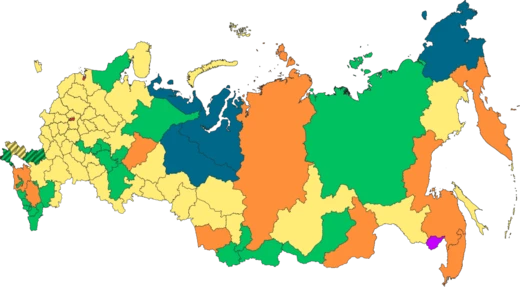
Moscow Oblast
A densely populated, highly industrialized federal subject of Russia.

Moscow Oblast, often called Podmoskovye, is a federal subject of Russia. It ranks as the country’s second most populous federal subject, with 8,524,665 residents recorded in the 2021 Census, and is one of Russia’s most densely settled areas, covering 44,300 square kilometers. The oblast lacks a single official administrative center; its public authorities are based in Moscow and Krasnogorsk (where the local government and the Moscow Oblast Duma are located), as well as in other locations throughout the region. Situated in European Russia between latitudes 54° and 57° N and longitudes 35° and 41° E, Moscow Oblast shares borders with Tver Oblast to the northwest, Yaroslavl Oblast to the north, Vladimir Oblast to the northeast and east, Ryazan Oblast to the southeast, Tula Oblast to the south, Kaluga Oblast to the southwest, and Smolensk Oblast to the west. The federal city of Moscow lies mostly surrounded by the oblast but is a separate federal subject in its own right. The region is heavily industrialized, with key sectors including metallurgy, oil refining, mechanical engineering, as well as food, energy, and chemical industries.
**Geography**
**Relief** The terrain is predominantly flat, with some hills reaching about 160 meters in the west and extensive lowlands in the east. From southwest to northeast, the oblast is crossed by the boundary of the Moscow glacier: north of this line, common ice-erosion forms with moraine ridges appear; to the south, only erosional landforms are found. The western and northern parts contain the Moscow Uplands, whose average height peaks near Dmitrov at about 300 meters, with a maximum of 310 meters near the village of Shapkino in Mozhaysky District. The northern slope of the uplands is steeper than the southern. Glacial lakes such as Nerskoye and Krugloye are found here. North of the Moscow Uplands lies the alluvial Verhnevolzhsk Depression, a marshy, flat area with heights between 120 and 150 meters. To the south stretches the hilly Moskvoretsko-Oksk plain, whose highest point—254 meters—is at Tyoply Stan, within Moscow city limits. This plain features clearly defined river valleys, especially in the south, and occasional karst relief, mostly in Serpukhovsky District. In the far south, beyond the Oka River, lies the Central Russian Upland, with numerous gullies and ravines, an average height above 200 meters, and a maxi
- Population
- 8,524,665 (2021 Census)
- Area
- 44,300 square kilometers (17,100 sq mi)
- Administrative Center
- None officially; public authorities in Moscow and Krasnogorsk
- Location
- European Russia, between 54°–57° N and 35°–41° E
- Bordering Oblasts
- Tver, Yaroslavl, Vladimir, Ryazan, Tula, Kaluga, Smolensk
- Highest Point
- 310 meters (1,020 ft) near the village of Shapkino in Mozhaysky District
- Lowest Natural Elevation
- 97 meters (318 ft) at the water level of the Oka River
Lore & Background
Moscow Oblast is mostly flat, with hills up to about 160 meters in the west and extensive lowlands in the east. The western and northern parts contain the Moscow Uplands, peaking at 310 meters near Shapkino. To the north lies the marshy Verhnevolzhsk Depression, while the south features the hilly Moskvoretsko-Oksk plain and the Central Russian Upland. The eastern part is dominated by the Meshchera Lowlands, with many glacial lakes and the region's lowest elevation at the Oka River (97 meters).
Reader's Guide
Moscow Oblast is significant as a major industrial and population center of Russia, surrounding but not including the federal city of Moscow. Its geology includes rich mineral deposits: quartz sand used in glass production since the late 17th century, refractory white clay extracted from the 14th century near Gzhel, and limestone used in Moscow buildings like the Bolshoi Theater. The oblast also contains deposits of phosphates, peat, brown coal, titanium, iron ore, potassium salts, and mineral springs. Its humid continental climate features short, warm summers and long, cold winters, with average January temperatures ranging from −9°C in the west to −12°C in the east. The region's diverse relief and resources have shaped its economic and historical development.
Did You Know?
- Moscow Oblast has no official administrative center; its public authorities are located in Moscow and Krasnogorsk.
- The highest point in the oblast is 310 meters near the village of Shapkino in Mozhaysky District.
- Quartz sand for glass production has been mined near Lyubertsy since the end of the 17th century.
- The lowest natural elevation in the oblast is the water level of the Oka River at 97 meters.
Administrative Uniqueness & Demographic Weight
Moscow Oblast, colloquially called Podmoskovye, occupies a singular niche in Russia's federal architecture. It possesses no single official administrative center; instead, its governing institutions are distributed. The Moscow Oblast Duma and local government are based in Krasnogorsk, while broader public authorities operate from Moscow and additional sites scattered across the territory. This dispersed arrangement mirrors the oblast's defining geographic role: it forms a near-complete ring around the capital city, which remains a wholly separate federal subject outside the oblast's jurisdiction. Demographically the region carries extraordinary weight. The 2021 Census recorded 8,524,665 residents across 44,300 square kilometers, making it the second most populous federal subject in Russia and one of the nation's most densely settled areas. The oblast encircles Moscow on virtually every side, touching eight neighboring regions in sequence from Tver in the northwest, through Yaroslavl, Vladimir, Ryazan, Tula, Kaluga, and Smolensk, creating a continuous arc of administrative and economic linkage to the capital.
Glacial Legacy & Topographic Range
The physical surface of Moscow Oblast is a layered record of ancient ice. Situated in the central East European craton, the territory bears the imprint of at least four Pleistocene glaciations. The Dnieper glacier swept across a vast stretch of the Russian Plain, while the Moscow glaciation halted just south of the present-day capital, leaving a distinct line of moraine ridges that still divides the terrain from southwest to northeast. The later Valdai glaciation never directly covered the oblast but deposited fluvioglacial sediments in the northern reaches. What the ice left behind is a striking topographic spread: the Moscow Uplands in the west and north climb to 310 meters near the village of Shapkino, the Meshchera Lowlands in the east dip to the Oka River's 97-meter water level, and the hilly Moskvoretsko-Oksk plain to the south features clearly defined river valleys and karst relief in Serpukhovsky District. Glacial-origin lakes such as Nerskoye, Krugloye, Chyornoye, and Svyatoye punctuate the landscape, while moraine loam studded with granite, gneiss, quartzite, dolomite, limestone, and sandstone boulders blankets the ground, reaching 100 meters thick at ridge crests.
Deep Geological Time & Mineral Endowment
Beneath the rolling surface, Moscow Oblast preserves a geological record reaching back to the Archaean and Proterozoic eras. The crystalline basement of the East European craton plunges to 4,200 meters east of Sergiyev Posad in the northeast, yet sits at just 1,000 meters in the far south near Serebryanye Prudy. Above this ancient foundation, sedimentary layers accumulated through the Palaeozoic, Mesozoic, and Cenozoic eras. A Cretaceous sea once flooded the northern reaches, leaving phosphate deposits and distinctive sands, while Jurassic black clay still surfaces in and around the Moscow River valley. Carboniferous dolomite, limestone, and marl, together with coal seams rich in organic remains in Serpukhovsky and the western districts, testify to even older environments. The region's mineral economy has long drawn on these strata. High-quality construction sands from Quaternary and Cretaceous sediments are mined widely, and quartz sand for glassmaking has been extracted near Lyubertsy since the late seventeenth century. Today the Yeganovskoye field holds 33 million tonnes of silica sand with annual output of 675,000 tonnes, while the Yeldiginskoye clay field near Sofrino offers 30 million cubic meters of fusible clay, producing 600,000 cubic meters per year.
Industrial Backbone & Economic Profile
Moscow Oblast ranks among Russia's most heavily industrialized territories, a status rooted in both its mineral endowments and its position as the immediate hinterland of the capital. The dominant sectors include metallurgy, oil refining, and mechanical engineering, supplemented by substantial food processing, energy generation, and chemical manufacturing. This industrial concentration is inseparable from the region's geology: the abundant sand, gravel, clay, and sandstone deposits described across the oblast supply raw materials for construction, glassmaking, and refractory production, while the coal-bearing Carboniferous strata in the south and west have historically supported energy and metallurgical operations. The oblast's economic gravity is further shaped by its administrative arrangement. Because public authorities are dispersed between Krasnogorsk, Moscow, and other points, industrial policy and infrastructure planning operate across a wide corridor rather than from a single hub. The result is a region where heavy industry, resource extraction, and proximity to the capital's markets and workforce create a tightly interwoven economic ecosystem that ranks second only to Moscow itself in population and economic significance among Russia's federal subjects.
Frequently Asked Questions
Who is Moscow Oblast?
Moscow Oblast, widely known by its nickname Podmoskovye, is a federal subject of Russia that essentially forms a ring around the capital city. It is the country's second most populous region, home to over 8.5 million people spread across roughly 44,300 square kilometers in European Russia.
What are Moscow Oblast's powers/role?
It operates as a densely industrialized and heavily populated region that underpins the capital's economic and logistical machinery. Its governing bodies split their operations between Moscow and Krasnogorsk, where the local executive and the Moscow Oblast Duma are housed, with no single officially designated administrative center.
How does Moscow Oblast's story end?
Because Moscow Oblast is a living, ongoing federal subject rather than a concluded narrative, there is no canonical ending to its arc. It continues to function as one of Russia's most active and densely settled regions, with no retirement or departure from the roster of federal subjects.
Why is Moscow Oblast important?
It ranks as the second most populous federal subject in all of Russia and anchors a critical industrial and population hub directly surrounding the national capital. Its sheer density and industrial output make it a cornerstone of the country's European-side economy.
Who are Moscow Oblast's neighbors and what's its terrain like?
It shares borders with seven other oblasts: Tver, Yaroslavl, Vladimir, Ryazan, Tula, Kaluga, and Smolensk. The region's landscape is largely low-lying, with its highest point reaching just 310 meters near the village of Shapkino in Mozhaysky District.
More in Russian Regions 1-24
Elsewhere in the Russian Regions universe
Spotted an error? Know more?
This is a living reference — every entry is fact-audited, and reader corrections feed straight into our audit queue. Suggest an edit · See this site's audit record