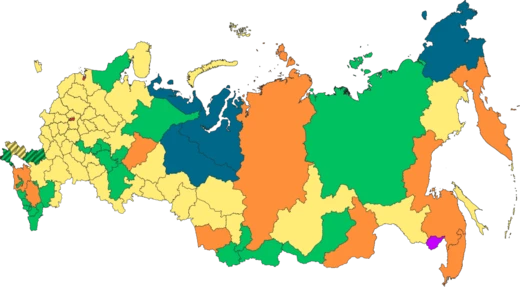
Stavropol Krai
Multi-ethnic Russian krai, birthplace of Gorbachev and Andropov.

Stavropol Krai, also known as Stavropolye, is a federal subject (a krai) of Russia located in the North Caucasus region of Southern Russia. It is administratively part of the North Caucasian Federal District, with Pyatigorsk serving as the district's administrative center, while Stavropol is the largest city and capital of the krai. Established as North Caucasus Krai in 1924, it underwent several administrative changes before being renamed Stavropol Krai in 1943. The region is notable for its multi-ethnic population, with thirty-three ethnic groups of more than 2,000 persons each, and for being the birthplace of two Soviet leaders, Mikhail Gorbachev and Yuri Andropov.
- type
- Federal subject (krai) of Russia
- capital
- Stavropol
- population_2021
- 2,907,593
- established
- October 17, 1924 (as North Caucasus Krai)
- renamed_Stavropol_Krai
- January 12, 1943
- area_irrigation_canals_2001
- 3,361 km
Lore & Background
Stavropol Krai was established on October 17, 1924 as North Caucasus Krai. After several administrative changes, it was renamed Ordzhonikidze Krai in March 1937, and finally Stavropol Krai on January 12, 1943. The region encompasses the central part of the Fore-Caucasus and most of the northern slopes of the Caucasus Major, bordered by Krasnodar Krai, Rostov Oblast, Kalmykia, Dagestan, Chechnya, North Ossetia–Alania, Kabardino-Balkaria, and Karachay–Cherkessia. Its western area is considered part of the Kuban region, traditional home of the Kuban Cossacks, and most of the population lives in the drainage basin of the Kuban River.
Reader's Guide
Stavropol Krai holds significance as a historically multi-ethnic region in the North Caucasus, with over 140 ethnic groups recorded in the 2010 Census. It is one of the most ethnically diverse federal subjects in Russia, with thirty-three groups each numbering more than 2,000 persons. The krai is also notable for producing two Soviet leaders: Mikhail Gorbachev, the last President of the Soviet Union, and Yuri Andropov, the fourth General Secretary. Gorbachev served as First Secretary of the Stavropol Krai Communist Party Committee from 1970 to 1978 before rising to national leadership. The region's legacy includes its role in the Kuban Cossack tradition and its development of extensive irrigation systems, including over 3,300 km of canals as of 2001. Religiously, a 2012 survey showed 46.9% of the population adheres to the Russian Orthodox Church, with significant numbers identifying as spiritual but not religious or atheist. The krai's climate is mostly hot-summer humid continental, with average January temperatures between -2°C and -6°C and July averages from 20°C to 25°C.
Did You Know?
- Stavropol Krai was renamed three times: North Caucasus Krai (1924), Ordzhonikidze Krai (1937), and Stavropol Krai (1943).
- Mikhail Gorbachev served as First Secretary of the Stavropol Krai Communist Party Committee from 1970 to 1978.
- The krai has 33 ethnic groups each with more than 2,000 persons, making it one of the most multi-ethnic federal subjects in Russia.
- As of 2001, Stavropol Krai had 3,361 km of irrigation canals, of which 959 km were lined.
Geography and Climate
Stavropol Krai occupies the central stretch of the Fore-Caucasus plateau and extends across most of the northern slopes of Caucasus Major. Its borders touch eight neighboring federal subjects, stretching from Rostov Oblast and Krasnodar Krai in the west and north-west, through Kalmykia to the north, Dagestan to the east, and down to Chechnya, North Ossetia–Alania, Kabardino-Balkaria, and Karachay-Cherkessia along the southern mountain frontier. The western portion of the territory is traditionally counted as part of the Kuban region, the historic homeland of the Kuban Cossacks, and the majority of residents live within the drainage basin of the Kuban River. Climate across the lowlands follows a hot-summer humid continental pattern, while mountain zones deviate from this norm. January averages sit between −2 °C and −6 °C, yet winter extremes can plunge to −35 °C. July typically registers 20 to 25 °C, with summer peaks reaching 40 °C. Annual rainfall falls in the 400-to-600-millimetre band, shaping a semi-arid agricultural landscape that demands extensive irrigation.
Political History and Notable Leaders
The territory was formally created on October 17, 1924, under the name North Caucasus Krai. It was later renamed Ordzhonikidze Krai in March 1937 to honor Sergo Ordzhonikidze, and finally received its current designation, Stavropol Krai, on January 12, 1943. During the Soviet era, real power in the region was concentrated in the hands of the First Secretary of the local Communist Party committee, who overshadowed both the Chairman of the Krai Soviet and the Chairman of the Krai Executive Committee. The krai produced two of the most consequential Soviet leaders: Mikhail Gorbachev, a native of the region who served as First Secretary from 1970 to 1978 before moving to Moscow and, seven years later, ascending to General Secretary and head of state; and Yuri Andropov, also a native son, who briefly led the Soviet Union. After the dissolution of the CPSU in 1991, governance shifted to an elected or appointed governor working alongside a regional Legislative Assembly, with the Krai Charter serving as the fundamental constitutional document and the Krai Government handling day-to-day executive matters.
A Mosaic of Peoples and Faiths
With a 2021 Census count of 2,907,593 residents—up from 2,786,281 in 2010 and 2,410,379 in 1989—Stavropol Krai stands as one of the most ethnically layered federal subjects in all of Russia. The 2010 Census recorded thirty-three ethnic groups each exceeding two thousand members, while residents in total identified with more than 140 distinct ethnicities. The population clusters around the Kuban and Kuma river basins, lands historically associated with the Kuban Cossacks, whose roots trace to Ukraine and whose dialect descended from that of the Cherkasy. Other significant communities include Christian Hamsheni Armenians, Armeno-Tats, Pontic Greeks, Ukrainians, Turkmens, and indigenous peoples from Chechnya, Ingushetia, and Dagestan. Religiously, a 2012 survey found 46.9 percent affiliated with the Russian Orthodox Church, seven percent identifying as unaffiliated generic Christians, two percent Muslim, one percent belonging to non-Russian Orthodox bodies or unchurched Orthodox believers, and one percent practicing Rodnovery or other local native faiths. By 2024, the region recorded a fertility rate of 1.26 children per woman and a total life expectancy of 71.66 years.
Irrigation Infrastructure and Industrial Base
Agriculture in Stavropol Krai depends heavily on a vast network of irrigation canals that, as of the start of 2001, stretched to 3,361 kilometres, of which 959 kilometres were lined with concrete or stone to minimize water seepage into the surrounding soil. Three major waterways define this system: the Nevinnomyssk Canal, which serves as the trunk of the Kuban–Yegorlyk Irrigation System; the Great Stavropol Canal, carrying Kuban River water eastward across the full width of the krai; and the Terek-Kuma Canal together with the Kuma–Manych Canal, which route Terek River water through the Kuma to the East Manych River. Beyond agriculture, the industrial landscape includes several large enterprises such as Stavrolen, Arnest, Concern Enorgomera, Nevinomiskiy Azot, and Stavropolskiy Gres. The krai's economic and administrative life is anchored by Stavropol, its largest city and capital, while Pyatigorsk holds the additional distinction of serving as the administrative center of the broader North Caucasian Federal District.
Frequently Asked Questions
Who is Stavropol Krai?
Stavropol Krai, nicknamed Stavropolye, is a federal subject in Russia's North Caucasus region, with Stavropol as its capital and largest city. It first appeared in 1924 as North Caucasus Krai and got its current name in January 1943 after a series of administrative reshuffles.
What are Stavropol Krai's powers or role?
As a krai, it operates as a full federal subject within the North Caucasian Federal District, while Pyatigorsk handles the broader district-level administrative duties. The region governs its own local affairs, agriculture, and infrastructure independently under that federal umbrella.
How does Stavropol Krai's story end?
There is no final chapter—Stavropol Krai is a living, ongoing region rather than a concluded narrative. As of 2021 it still counts roughly 2.9 million residents and continues to function as an active federal subject in the North Caucasus.
Why is Stavropol Krai important to the canon?
It stands out for hosting thirty-three ethnic groups each numbering over 2,000 people, making it one of the most culturally layered regions in the setting. It is also the shared birthplace of both Gorbachev and Andropov, two figures who shaped the broader political storyline.
What is Stavropol Krai's origin story?
The region debuted in October 1924 under the banner of North Caucasus Krai, then endured multiple name and boundary changes before settling on its current identity in 1943. Its agricultural backbone—over 3,300 kilometres of irrigation canals—became a signature part of its early development arc.
More in Russian Regions 1-24
Elsewhere in the Russian Regions universe
Spotted an error? Know more?
This is a living reference — every entry is fact-audited, and reader corrections feed straight into our audit queue. Suggest an edit · See this site's audit record