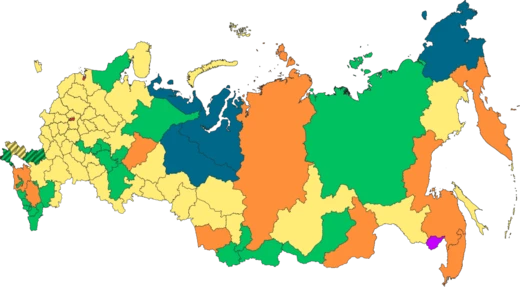
Sakha Republic
World's largest subnational entity, extreme cold, diamond-rich republic.

The Sakha Republic, officially the Republic of Sakha (Yakutia), is a federal subject of Russia and the largest country subdivision in the world by area, covering over 3,083,523 square kilometers. Located in the Russian Far East along the Arctic Ocean, it is known for its extreme climate, with the Northern Hemisphere's Pole of Cold at Verkhoyansk and Oymyakon. Its capital, Yakutsk, is the world's coldest major city. The republic is significant for its vast natural resources, producing 99% of Russian diamonds and over 25% of the world's diamonds, and for its role in Pleistocene paleontology, including preserved prehistoric animal remains.
- area
- 3,083,523 km² (largest subnational entity in the world)
- capital
- Yakutsk (world's coldest major city)
- population
- One million
- climate_note
- Second lowest Northern Hemisphere temperatures recorded in Verkhoyansk and Oymyakon (lowest −67.8 °C)
- diamond_production
- 99% of Russian diamonds, over 25% of world diamonds
- time_zones
- Three (only Russian federal subject with more than one)
Lore & Background
Sakha was originally inhabited by hunting-gathering and reindeer herding Tungusic and Paleosiberian peoples, such as the Evenks and Yukaghirs. The Turkic Sakha people migrated from the Lake Baikal area to the middle Lena River between the 9th and 16th centuries, likely in several waves, bringing an Inner Asian pastoral economy. Russian colonization began in the early-mid 17th century, incorporating the area as Yakutsk Oblast and imposing fur tribute on indigenous peoples; the Sakha population dropped by 70% in the initial period, but later expanded along the Vilyuy River, displacing other groups.
Reader's Guide
The Sakha Republic's significance lies in its extreme geography and climate, its status as the world's largest subnational entity, and its immense natural resource wealth, particularly diamonds. The region's permafrost and arctic conditions have preserved Pleistocene-era animal remains, contributing to paleontological research. Politically, it transitioned from a Russian imperial oblast to the Yakut ASSR under the Bolsheviks in 1922, then to the Yakutskaya-Sakha Soviet Socialist Republic in 1990, and finally to the Republic of Sakha (Yakutia) in 1991. Its hypercontinental climate, with winter averages below −35 °C in Yakutsk and summer warmth, shapes its ecology, which includes tundra, taiga forests (47% of the republic), and permafrost. The republic's three time zones and extensive river system, including the Lena River, further define its character. The Pleistocene Park project aims to recreate ancient tundra grasslands by reintroducing large herbivores.
Did You Know?
- Sakha is the only Russian federal subject that uses more than one time zone—it spans three.
- The republic contains over 800,000 lakes.
- The Northern Hemisphere's Pole of Cold is at Verkhoyansk and Oymyakon, where temperatures reached −67.8 °C.
- Sakha produces 99% of all Russian diamonds and over 25% of the world's diamonds.
Scale & Geographic Vastness
No other subnational entity on Earth rivals the sheer expanse of Sakha. Stretching 2,500 kilometers from its northernmost reaches at Henrietta Island down to its southern borders, and 2,000 kilometers across, the republic encompasses over 3,083,523 square kilometers of territory. That makes it slightly smaller than India yet still larger than Argentina, and it accounts for half the land area of its parent Far Eastern Federal District. It is also the only Russian federal subject that spans three distinct time zones. The landscape is shaped by permafrost, which blankets the entire republic and confines forests to the southern reaches. Three broad vegetation zones define the terrain: Arctic and subarctic tundra where lichen and moss form vast green carpets and support reindeer herds; scattered dwarf Siberian pine and larch along river corridors; and a sweeping taiga belt covering roughly 47 percent of the land, dominated almost entirely by larch. The Lena River, at 4,400 kilometers, threads northward through the Verkhoyansk Range, and more than 800,000 lakes dot the surface. The highest point, Peak Pobeda, rises to 3,003 meters.
Climate of Superlatives
Sakha's climate is among the most extreme anywhere on the planet. The settlements of Verkhoyansk and Oymyakon have recorded the second-lowest temperatures ever measured in the Northern Hemisphere, surpassed only by readings at Summit Camp in Greenland. In the capital, Yakutsk—widely regarded as the coldest major city on Earth—winter averages routinely plunge below minus 35 degrees Celsius. Yet the same hypercontinental pattern that drives such brutal cold also produces surprisingly warm summers across much of the republic, creating a seasonal swing of extraordinary magnitude. To the north, the Laptev and Eastern Siberian Seas, which form part of the Arctic Ocean coastline, are the coldest and most ice-bound waters in the entire Northern Hemisphere, locked under ice for nine to ten months each year. The republic's northernmost territory, including the New Siberian Islands, sits in a zone where the Arctic Circle encloses roughly forty percent of the land, and permafrost underlies every square kilometer, fundamentally shaping ecology, hydrology, and the very possibility of settlement.
Peoples, Names, and Migration
Long before the Turkic Sakha arrived, the lands that would become the republic were home to Tungusic and Paleosiberian communities such as the Evenks and Yukaghir, who sustained themselves through hunting, gathering, and reindeer herding. The Sakha themselves migrated in multiple waves between the 9th and 16th centuries from the Lake Baikal region to the middle Lena River, carrying with them the pastoral economic traditions of Inner Asia. The name by which outsiders know them—Yakut—originates in the Evenk word Yako (rendered variously as yoqo, ñoqa, or ñoka), a label the Evenks applied to their neighbors. The Yukaghirs have their own variants, yoqol or yaqal, depending on the dialect. Intriguingly, the Sakha self-designation may trace back to the same proto-root, *jaqa, which through regular sound changes in the Yakut language evolved into Sakha. The Dolgans, whose language is a close relative of Yakut, pronounce the name as Haka, preserving an older phonetic form.
From Conquest to Republic
The Russian Tsardom absorbed the region in the early-to-mid 17th century, establishing the Yakutsk Oblast and imposing a fur-tribute system on the indigenous populations. The initial shock of conquest was devastating: the Sakha population fell by roughly seventy percent. Yet the Imperial era also witnessed a remarkable geographic expansion of the native Yakuts, who spread from the middle Lena along the Vilyuy River toward the north and east, displacing other indigenous groups in the process. The turbulent years of the Russian Civil War brought some of its final battles to Yakutian soil. In 1922, the Bolshevik government reorganized the territory into the autonomous Yakut ASSR, and the Soviet decades that followed saw large-scale migration of Slavic peoples, particularly Russians and Ukrainians, into the region. On 27 September 1990, the area was redesignated the Yakutskaya-Sakha Soviet Socialist Republic, and just three months later, on 27 December 1991, it formally became the Republic of Sakha (Yakutia), the sovereign entity it remains today, home to approximately one million people.
Frequently Asked Questions
Who is Sakha Republic?
The Sakha Republic, also called Yakutia, is a federal subject of Russia situated in the Far East along the Arctic coast. It holds the record as the largest subnational entity on Earth, spanning roughly 3.08 million square kilometers.
What are Sakha Republic's powers or role?
The republic dominates global diamond supply, accounting for 99% of Russia's output and more than a quarter of all diamonds mined worldwide. It also serves as a major site for Pleistocene paleontology and hosts three time zones, a distinction no other Russian region shares.
How does Sakha Republic's story end?
There is no narrative 'ending'—Sakha Republic remains an active federal subject today. Its ongoing significance lies in its resource extraction, its role in Arctic research, and its status as home to Yakutsk, the coldest major city on the planet.
Why is Sakha Republic important?
Beyond its sheer size and diamond wealth, the region holds the Northern Hemisphere's record low temperature of −67.8 °C, recorded at Verkhoyansk and Oymyakon. This extreme cold, combined with its vast untapped land, makes it a critical player in both climate science and global mineral markets.
What is Sakha Republic's capital and how big is the population?
Yakutsk serves as the capital and is recognized as the world's coldest major city. The republic's population stands at approximately one million people spread across an area larger than most entire countries.
More in Russian Regions 1-24
Elsewhere in the Russian Regions universe
Spotted an error? Know more?
This is a living reference — every entry is fact-audited, and reader corrections feed straight into our audit queue. Suggest an edit · See this site's audit record