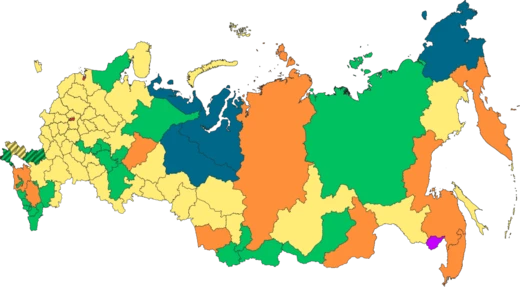
Saratov Oblast
A Russian oblast in the Volga region with critical ecological challenges.

Saratov Oblast is a federal subject of Russia (an oblast) located in the Volga Federal District, with its administrative center at the city of Saratov. As of the 2021 Census, its population was 2,442,575. The oblast is situated in the southeast of European Russia, in the northern part of the Lower Volga region, and borders Volgograd, Voronezh, Tambov, Penza, Samara, and Ulyanovsk oblasts, as well as Kazakhstan's West Kazakhstan Region.
- type
- Federal subject of Russia (oblast)
- administrative_center
- Saratov
- population_2021
- 2,442,575
- area_length_west_east
- 575 km
- area_length_north_south
- 330 km
- highest_point
- 369 m (unnamed hill, Khvalynsk Mountains)
- federal_district
- Volga Federal District
Lore & Background
Saratov Oblast lies in the southeast of European Russia, spanning 575 kilometers from west to east and 330 kilometers from north to south. Its highest point is an unnamed hill of the Khvalynsk Mountains reaching 369 meters. The oblast is divided by the Volga River and contains valuable chernozyom and chestnut soils, as well as numerous water resources and mineral-water deposits. More than 40 small oil and gas fields have been explored, along with oil shale, phosphorites, and construction materials. The climate features long, dry, hot summers and frosty winters, with the Voeykov axis crossing the region and affecting weather patterns.
Reader's Guide
Saratov Oblast is significant as a populous and resource-rich region of Russia, but its modern ecological state is described as critical. Intensive pollution from fuel, chemical, and petrochemical industries continues, with environmental damage increasing alongside economic growth. The oblast faces dangerous natural processes such as landslides, karst, earthquakes, and flooding. Industrial waste dumps contain 24 million tons of waste, including phosphogypsum from Irgiz OJSC in Balakovo, where pollution exceeds maximum permissible concentrations for phosphates, chlorides, iron, ammonia, and nitrates. Unauthorized landfills are growing, and the government lacks control or monitoring. Annually, enterprises emit up to 50 million tons of harmful substances into the atmosphere. Despite a program for stabilization and improvement of the ecological situation, measures to stop negative impacts are not taken. Historically, the area was home to the Eneolithic Khvalynsk culture and the Golden Horde city of Uvek, destroyed by Tamerlane. The region later became part of the Kazan Khanate and then the Russian state after Ivan IV's conquest.
Did You Know?
- The highest point of Saratov Oblast is an unnamed hill of the Khvalynsk Mountains reaching 369 meters above sea level.
- More than 40 small oil and gas fields have been explored in the region.
- In 2011, Saratov was excluded from the list of Russian cities with very high levels of air pollution.
- The Eneolithic Khvalynsk culture (V-IV thousand BC) is named after the town of Khvalynsk.
Geography & Natural Wealth
Saratov Oblast occupies the southeastern corner of European Russia, stretching across the northern reach of the Lower Volga region. Its territory spans 575 kilometers west to east and 330 kilometers north to south, ringed by Volgograd Oblast to the south, Voronezh and Tambov oblasts to the west, Penza, Samara, and Ulyanovsk oblasts to the north, and Kazakhstan's West Kazakhstan Region to the east. The land's highest point is an unnamed hill in the Khvalynsk Mountains at 369 meters above sea level. The Volga River splits the oblast into two halves, and the region is further endowed with numerous identified water sources and mineral-water deposits. Agriculturally, the oblast benefits from valuable ordinary and southern chernozem soils alongside widespread chestnut soils. More than forty small oil and gas fields have been explored, with promising areas still awaiting development. Significant reserves of oil shale—including the large Ozinskoye deposit—along with cement raw materials, phosphorites, construction and glass sands, ballast materials, clay, and stone round out a diverse mineral portfolio.
Climate & Seasonal Rhythms
The oblast's temperate climate is shaped in part by the Voeykov axis, a climatic dividing and wind-destroying line that typically threads through the eastern and northern districts but can drift southward or push northward, particularly in spring, altering local conditions. Summers are long, dry, and intensely hot; on the Volga's left bank, a considerable number of days each year exceed 30 °C. Winters bring frost, with 12 to 15 days of precipitation per month, 4 to 10 days of fog, and 4 to 10 days of snowstorms. Spring is notably brief: March sees snowstorms and road drifts on an average of 5 to 7 days, while fog lingers 5 to 9 days. From the last decade of March through the third decade of April, heavy-vehicle traffic on hard-surface roads is restricted until average daily temperatures cross zero. A stable snow cover appears by November 25 in the north and between November 29 and December 8 in central and southern areas. Autumn weather lacks year-to-year consistency, and the region remains vulnerable to landslides, karst activity, earthquakes, and flooding.
Ecological Crisis & Industrial Pollution
The environmental condition of Saratov Oblast is widely regarded as critical, with damage accelerating in step with industrial output. Fuel, chemical, and petrochemical sectors are expanding faster than the Russian average, and regional enterprises release up to 50 million tons of harmful substances—carbon monoxide, nitrogen oxides, and others—into the atmosphere each year. Dumps and enterprise storehouses hold 24 million tons of industrial waste: 3,500 tons of Class 1 (most hazardous) material from plants including Tantalus, Banner of Labor, SAZ, AIT, ELMASH, and SEPO; roughly 5,000 tons of Class 2; about 3 million tons of Class 3; and approximately 21 million tons of Class 4. The AIT plant in Saratov has long discharged nickel- and cadmium-bearing production waste into the Alexander Village landfill, contaminating neighboring residential areas. In Balakovo, Irgiz OJSC has piled over 19 million tons of phosphogypsum—nearly double the site's 10.84-million-ton design capacity—with phosphate, chloride, iron, ammonia, and nitrate concentrations tens of times above permissible limits. Unauthorized landfills continue to multiply, and the only visible countermeasure is seasonal volunteer cleanups known as subbotniks.
Economic Profile & the Cost of Growth
Saratov Oblast's economy is anchored in the fuel, energy, and petrochemical complex, which forms the core of its export portfolio. Foreign trade turnover surged by 36.8 percent in 2011, a reflection of chemical and petrochemical production expanding well above the national average. Machine-building products continue to be shipped to countries of the near abroad. The region's more than forty explored oil and gas fields, extensive oil shale deposits, and rich mineral resources—phosphorites, cement raw materials, construction sands, clay, and stone—supply the raw material base for these industries. Yet this industrial momentum carries a heavy environmental price: the very sectors driving export revenue are the principal sources of atmospheric pollution and the 24 million tons of hazardous waste stored in regional dumps. The Committee for Environmental Protection and Nature Management drafted a stabilization program financed through multi-level budgets, environmental funds, and enterprise contributions, yet the overall ecological trajectory shows no measurable improvement, and uncontrolled emissions and industrial accidents remain persistent regional threats.
Frequently Asked Questions
What is Saratov Oblast and where does it sit in Russia's structure?
Saratov Oblast is a federal subject (oblast) belonging to the Volga Federal District, with the city of Saratov serving as its administrative capital. It occupies the southeast corner of European Russia within the broader Lower Volga region.
What are Saratov Oblast's borders and approximate size?
The oblast stretches roughly 575 km from west to east and 330 km from north to south. It shares boundaries with Volgograd, Voronezh, Tambov, Penza, Samara, and Ulyanovsk oblasts, plus Kazakhstan's West Kazakhstan Region to the south.
How many people call Saratov Oblast home?
The 2021 Census recorded a population of about 2.44 million residents. That places it as a mid-sized oblast within the Volga Federal District.
What is the highest point in Saratov Oblast?
An unnamed hill in the Khvalynsk Mountains rises to 369 meters above sea level, making it the oblast's peak. Despite the 'mountains' label, the overall terrain remains relatively low-lying compared to Russia's major ranges.
Why do fans and residents highlight Saratov Oblast's ecological profile?
Its position in the Lower Volga region ties the oblast directly to critical river-ecosystem pressures and land-use challenges. Environmental stewardship along the Volga corridor is a defining concern that sets the region apart in discussions of Russian federal subjects.
More in Russian Regions 1-24
Elsewhere in the Russian Regions universe
Spotted an error? Know more?
This is a living reference — every entry is fact-audited, and reader corrections feed straight into our audit queue. Suggest an edit · See this site's audit record