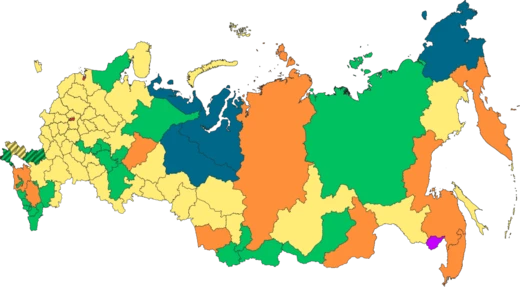
Russian Far East
Easternmost region of Russia, coextensive with the Far Eastern Federal District.

The Russian Far East is a region in North Asia, constituting the easternmost part of Russia and the Asian continent. It is coextensive with the Far Eastern Federal District, encompassing the area between Lake Baikal and the Pacific Ocean, with Khabarovsk as its largest city. Historically, it has been categorized separately from Siberia in Russian regional schemes, and during the Soviet era it was called the Soviet Far East.
- Area
- 6.2 million square kilometres (over one-third of Russia's total area)
- Largest city
- Khabarovsk
- Second largest city
- Vladivostok
- International land borders
- Mongolia, China, North Korea
- Maritime boundaries
- Japan (southeast), United States (northeast, along the Bering Strait)
- Federal district established
- 2000
Lore & Background
Russians reached the Pacific coast in 1647 with the establishment of Okhotsk, and the Russian Empire consolidated control over the region in the 19th century after annexing part of Chinese Manchuria (1858–1860). Primorskaya Oblast was established in 1856 with its administrative center at Khabarovsk. Several entities named 'Far East' existed in the first half of the 20th century, including the Far Eastern Republic (1920–1922) and Far-Eastern Krai (1926–1938). Until 2000 the region lacked officially defined boundaries; the term 'Siberia and the Far East' was often used without clear distinction.
Reader's Guide
The Russian Far East's significance stems from its strategic location as Russia's Pacific gateway, its vast size (over one-third of Russia's total area), and its role in historical conflicts. The Russo-Japanese War (1904–1905) was driven by Russia's quest for a warm-water port, leading to the loss of southern Sakhalin and the lease of the Liaodong Peninsula to Japan. During the Soviet era, the region saw forced deportations of Koreans (1937–1939) and reliance on Gulag labor camps for development. In World War II, Primorsky Krai served as the Soviet Pacific headquarters for planning an invasion of Japan through Korea. The Cold War made Vladivostok a closed city due to Soviet Pacific Fleet bases, and the region was a site of the 1974 Strategic Arms Limitation Talks. Its legacy includes ongoing territorial disputes and its role as a distinct administrative and cultural entity within Russia.
Did You Know?
- The Russian Far East is coextensive with the Far Eastern Federal District, which was created in 2000.
- In November 2018, Zabaykalsky Krai and the Republic of Buryatia were added to the Far Eastern Federal District, having previously been part of the Siberian Federal District.
- Between 1937 and 1939, the Soviet Union deported over 200,000 Koreans from the region to Uzbekistan and Kazakhstan, fearing they might act as spies for Japan.
- The region's largest city is Khabarovsk, followed by Vladivostok.
Geography & Strategic Position
The Russian Far East stretches from the shores of Lake Baikal all the way to the Pacific Ocean, making it the easternmost territory of both Russia and the entire Asian continent. Defined by the boundaries of the Far Eastern Federal District, the region covers roughly 6.2 million square kilometres—more than a third of Russia's total land area. Its international borders are remarkably diverse: land frontiers run along Mongolia, China, and North Korea to the south, while maritime boundaries separate it from Japan to the southeast and from the United States across the Bering Strait to the northeast. The landscape is dramatic and varied, featuring the towering Klyuchevskaya Sopka volcano, the immense Kuril–Kamchatka Trench, the ancient Beyenchime-Salaatin impact crater, and the world-renowned Lake Baikal. The two largest urban centers are Khabarovsk and Vladivostok, serving as anchors in an otherwise sparsely populated expanse.
Imperial Expansion & Consolidation
Russian presence on the Pacific coast dates back to 1647, when the settlement of Okhotsk was established, marking the first permanent foothold in the region. However, genuine imperial consolidation did not arrive until the nineteenth century. In 1856, the Russian Empire carved out Primorskaya Oblast as a distinct administrative unit, placing Khabarovsk at its administrative heart. The annexation of portions of Chinese Manchuria between 1858 and 1860 further expanded Russian territorial claims in the area. Vladivostok, founded in 1860, would go on to become a critical Pacific seaport, though in its early decades it functioned only during the summer months. These moves transformed the Far East from a distant frontier into a strategically managed imperial province, with borders that would later become flashpoints in international conflict.
The Russo-Japanese War & Its Aftermath
In the early 1900s, Russia's persistent desire for a year-round warm-water Pacific port drove it into a collision course with Japan. Vladivostok, though established in 1860, could only operate in summer, while Port Arthur—leased from China in 1896—offered all-season access. After the First Sino-Japanese War of 1894–1895 and the collapse of 1903 negotiations, Japan declared war on 8 February 1904. In a stunning pre-emptive strike, the Imperial Japanese Navy attacked Russia's 1st Pacific Squadron at Port Arthur just three hours before the formal declaration reached the Russian government. Russia responded eight days later. The conflict ended in September 1905 with Japan's victory, formalized by the Treaty of Portsmouth. Russia ceded the southern half of Sakhalin, and Japan secured the Liaodong Peninsula and the southern Manchurian rail system. In 1907, Japan further pressured Russia to confiscate land from Korean settlers who constituted the majority of Primorsky Krai's population.
Soviet-Era Upheaval & Administrative Identity
The political identity of the Russian Far East was in constant flux during the Soviet period. Between 1918 and 1938, at least four distinct administrative entities bore the 'Far East' name, each with different territorial boundaries—ranging from the Far Eastern Republic (1920–1922) to the Far-Eastern Krai (1926–1938). Until 2000, the region lacked officially defined borders, often lumped together with Siberia under the vague label 'Siberia and the Far East.' The creation of the Far Eastern Federal District in 2000 finally gave the area a coherent administrative framework, and in November 2018, Zabaykalsky Krai and the Republic of Buryatia were added from the Siberian Federal District. The human cost of Soviet policy was severe: between 1937 and 1939, over 200,000 Koreans were deported to Uzbekistan and Kazakhstan on cattle trains, many dying en route. Remote northern development relied heavily on Gulag labor until Stalin's death in 1953, after which volunteer workers drawn by higher wages gradually replaced forced labor.
Frequently Asked Questions
What is Russian Far East?
It is the easternmost stretch of Russia, spanning from the shores of Lake Baikal all the way to the Pacific coastline. In administrative terms, it maps directly onto the Far Eastern Federal District.
How big is Russian Far East relative to the rest of the country?
At roughly 6.2 million square kilometres, this single region accounts for more than a third of Russia's total landmass. It is by far the most spatially dominant zone on the national map.
Who are Russian Far East's key cities?
Khabarovsk holds the title of the region's largest city, while Vladivostok serves as the second-largest and the primary Pacific-facing port hub.
Who does Russian Far East border on land and sea?
On land it touches Mongolia, China, and North Korea, while across the water it faces Japan to the southeast and the United States to the northeast via the Bering Strait.
When did Russian Far East receive its current administrative identity?
The Far Eastern Federal District was formally established in 2000, although Russian geographers had long treated this area as a distinct zone separate from Siberia. During the Soviet period it was commonly known as the Soviet Far East.
More in Russian Regions 1-24
Elsewhere in the Russian Regions universe
Spotted an error? Know more?
This is a living reference — every entry is fact-audited, and reader corrections feed straight into our audit queue. Suggest an edit · See this site's audit record