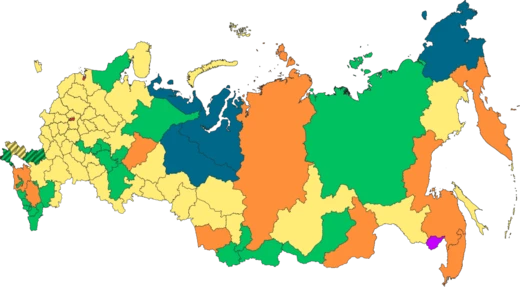
Tatarstan
A republic of Russia with a rich Volga Bulgar heritage.

Tatarstan, officially the Republic of Tatarstan and also known as Tataria, is a federal subject of Russia situated in Eastern Europe. It belongs to the Volga Federal District, and its capital, Kazan, serves as a major cultural hub within the country. The republic’s economy is primarily driven by oil, with a well-developed petrochemical sector.
The republic shares borders with Kirov, Ulyanovsk, Samara, and Orenburg Oblasts, as well as the republics of Mari El, Udmurtia, Chuvashia, and Bashkortostan. Tatarstan maintains close cultural, linguistic, and ethnic connections with its eastern neighbor, Bashkortostan, another Russian republic. Covering 68,000 square kilometers (26,000 square miles), Tatarstan makes up 0.4% of Russia’s total land area. According to the 2021 census, its population stood at 4,004,809.
The first known organized state in the region was Volga Bulgaria, which adopted Islam in 922—an event commemorated annually in the city of Bolgar. Later historical entities included the Golden Horde and the Khanate of Kazan, before the area was conquered by Russia. In 1920, the modern Tatar state was established as the Tatar Autonomous Soviet Socialist Republic (Tatar ASSR) within the Russian SFSR. It was renamed the Republic of Tatarstan in 1992 and became a federal subject of Russia.
The official languages are Tatar and Russian. The head of the republic is Rustam Minnihanov. Religious leadership includes mufti Kamil Samigullin and metropolitan bishop Cyril Nakonechny.
**Etymology**
The name “Tatarstan” combines the ethnonym “Tatars” with the Persian suffix “-stan,” meaning “state” or “country of,” a common ending for many Eurasian nations. During the Soviet era, the Russian name “Татария” (Tatariya) was also official, alongside “Tatar ASSR.” Alternative spellings of the Persian suffix sometimes use “i” or “e” after a consonant; for instance, Turkish renders it as “Tataristan,” and occasionally in Tatar it appears as “Tatarıstan” (Татарыстан). Besides the official “Tatarstan respublikası,” the name “Tatarstan Cömhüriyäte” (Татарстан Җөмһүрияте, from Arabic جمهورية) is also used.
**Geography**
Tatarstan lies in the center of the East European Plain, about 800 kilometers (500 miles) east of Moscow. It is situated between the Volga and Kama Rivers (the Kama being a Volga tributary) and extends eastward toward the Ural Mountains. Oak is the dominant tr
- Capital
- Kazan
- Area
- 68,000 square kilometres (26,000 mi²)
- Population (2021 census)
- 4,004,809
- Official languages
- Tatar and Russian
- Head of republic
- Rustam Minnihanov
- Major natural resource
- Oil, natural gas, gypsum
Lore & Background
The earliest known organised state within Tatarstan's boundaries was Volga Bulgaria, which adopted Islam in 922. This event is celebrated yearly in the city of Bolgar. Later historical predecessors include the Golden Horde and the Khanate of Kazan, before the region was conquered by Russia. In 1920, the modern Tatar state, the Tatar ASSR, was founded as an autonomous republic of the Russian SFSR; it was renamed the Republic of Tatarstan in 1992 and became a federal subject of Russia.
Reader's Guide
Tatarstan's significance lies in its historical role as a centre of Volga Bulgar and Tatar statehood, its adoption of Islam in 922, and its modern status as a major oil-producing republic within Russia. The region has strong cultural, linguistic, and ethnic ties with neighbouring Bashkortostan. Its capital, Kazan, is a key cultural hub. The republic's official languages are Tatar and Russian, and its head is Rustam Minnihanov. Tatarstan's constitution initially defined it as a sovereign state, but later amendments removed that term, and its 1994 autonomy agreement expired in 2017, making it the last republic of Russia to lose its special status.
Did You Know?
- The earliest known organised state within Tatarstan was Volga Bulgaria, which adopted Islam in 922.
- Tatarstan's main source of wealth is oil, with an estimated over one billion tons of oil deposits.
- The republic's forest cover decreased from 51.2% to 17.1% over the last 300 years.
- The name 'Tatarstan' derives from the Tatars and the Persian suffix -stan, meaning 'state' or 'country'.
More in Russian Regions 1-24
Elsewhere in the Russian Regions universe
Spotted an error? Know more?
This is a living reference — every entry is fact-audited, and reader corrections feed straight into our audit queue. Suggest an edit · See this site's audit record