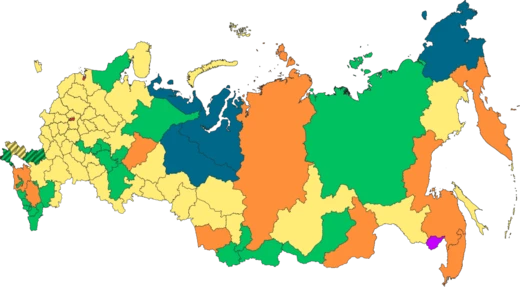
Tyumen Oblast
Russia's richest federal subject, leading oil and gas producer.

Tyumen Oblast is a federal subject (an oblast) of Russia, located in Western Siberia and administratively part of the Ural Federal District. It is the third-largest federal subject by area and has a population of 3,395,755 (2010). The oblast is the largest producer of oil and natural gas in the country, and has experienced an oil boom since the early 2000s, making it by far the richest federal subject of Russia with an average GDP per capita several times the national average since 2006.
- established
- August 14, 1944
- area
- 160,100 km²
- population
- 3,395,755 (2010 census)
- administrative_center
- Tyumen
- time_zone
- Yekaterinburg time zone (UTC+5; MSK+2)
- GDP_nominal_2016
- ₽5.9 trillion ($104 billion)
- GDP_per_capita_2016
- $28,000
Lore & Background
Tyumen Oblast was founded on August 14, 1944. It includes two autonomous okrugs: Khanty-Mansi and Yamalo-Nenets. The territory covers 160,100 km² and is located in the basin of several major rivers, including the Ob and Irtysh. The climate ranges from arctic in the north to humid continental in the south, with extreme conditions in the Far North areas. The region contains more than 70,000 watercourses and about 70,000 lakes.
Reader's Guide
Tyumen Oblast's significance stems from its dominant role in Russia's oil and gas industry. The autonomous okrugs concentrate the bulk of the country's oil and gas, with major fields such as Samotlor, Urengoy, and Yamburg. This has driven rapid economic growth since the early 2000s, making the oblast the richest federal subject by GDP per capita. The region also holds substantial forest resources, peat, and mineral deposits, including vivianite. Its multicultural population includes over thirty-six recognized ethnic groups, with Russians forming the majority. The oblast's politics are governed by its Charter, with a governor and elected Legislative Assembly.
Did You Know?
- Tyumen is the first Russian city in Siberia.
- The oblast contains about 20% of world reserves of vivianite (ferric phosphate).
- The polar bear sub-population in the extreme north is genetically distinct from other circumpolar regions.
- The region has more than 70,000 watercourses with a total length of 584,400 km.
More in Russian Regions 1-24
Elsewhere in the Russian Regions universe
Spotted an error? Know more?
This is a living reference — every entry is fact-audited, and reader corrections feed straight into our audit queue. Suggest an edit · See this site's audit record