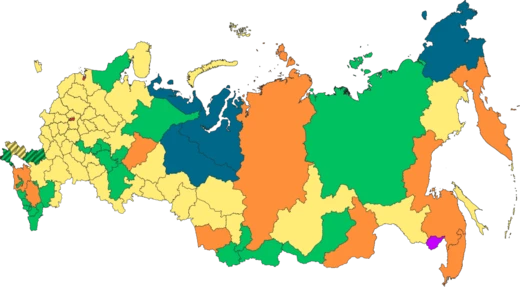
Ulyanovsk Oblast
Russian oblast formed in 1943, named for Vladimir Lenin.

Ulyanovsk Oblast is a federal subject of Russia (an oblast) located in the Volga Federal District. Its administrative center is the city of Ulyanovsk, and it has a population of 1,292,799 (2010 Census). The oblast corresponds to the former Simbirsk Governorate, which was renamed in 1924 in honor of Vladimir Lenin (born Ulyanov), who was born in Simbirsk. The present-day oblast was formed in 1943 by merging parts of Kuybyshev and Penza Oblasts.
- Founded
- 1943
- Administrative Center
- Ulyanovsk
- Population (2010 Census)
- 1,292,799
- Area
- Corresponds to former Simbirsk Governorate
- Federal District
- Volga Federal District
- Climate
- Warm-summer humid continental (Köppen dfb)
Lore & Background
The first settlements in the Middle Volga region date back more than 100,000 years. In the 8th and 9th centuries, the area became part of Volga Bulgaria. After devastation by Tamerlane in the late 14th–early 15th century, it became part of the Kazan Khanate in the late 1430s. Russians gradually settled the territory, mingling with local Tatars. In the late 1640s, construction of the Karsunsky-Simbirsk defense line began under Bogdan Hitrovo. Twenty-two years after its founding, the city of Simbirsk withstood a siege by Cossacks led by Ataman Stepan Razin.
Reader's Guide
Ulyanovsk Oblast holds significance as the region of Vladimir Lenin's birth and as a key rear area during World War II, hosting evacuated enterprises and people from western regions. Its history includes the Bolshevik takeover in December 1917, the recapture of Simbirsk from White forces in September 1918, and post-war industrial development in the 1950s–1960s, including a factory of heavy and unique machines and the Dimitrovgrad Research Institute of Atomic Reactors. The oblast signed a power-sharing agreement with Russia in 1997, which was abolished in 2001. Its geography spans the Volga River, with deciduous forests, steppes, and chernozem soils, and it contains protected areas such as the Sengiley Mountains national park and the Undory mineral source.
Did You Know?
- Ulyanovsk Oblast was formed in 1943 from parts of Kuybyshev and Penza Oblasts.
- The oblast is named after Vladimir Lenin, who was born in Simbirsk (renamed Ulyanovsk in 1924).
- A quarter of its territory is covered with deciduous forests; the rest is steppes and meadows.
- The oblast has a concentrated wasp population.
More in Russian Regions 1-24
Elsewhere in the Russian Regions universe
Spotted an error? Know more?
This is a living reference — every entry is fact-audited, and reader corrections feed straight into our audit queue. Suggest an edit · See this site's audit record