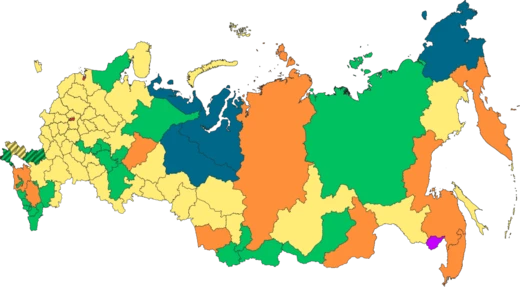
Vladimir Oblast
A Russian oblast with UNESCO cathedrals and diverse wildlife.

Vladimir Oblast is a federal subject of Russia (an oblast), with its administrative center in the city of Vladimir, located 190 kilometers east of Moscow. As of the 2010 Census, its population was 1,443,693. The oblast is historically significant for its 12th-century cathedrals, several of which are UNESCO World Heritage sites, and for its role in the development of the Vladimir-Suzdal principality.
- Administrative center
- Vladimir
- Population (2010 Census)
- 1,443,693
- Area
- Part of the East European Plain
- Major rivers
- Klyazma and Oka
- UNESCO sites
- 12th-century cathedrals in Vladimir, Suzdal, Bogolyubovo, and Kideksha
- Established as separate oblast
- 14 August 1944
Lore & Background
The territory of modern Vladimir Oblast has been inhabited since the Upper Paleolithic, with a Homo sapiens settlement at Sungir dating between 32,050 BC and 28,550 BC. The region was home to Slavs, Tatars, Finno-Ugrics, and Balts, including the East Slavic Buzhans and Finno-Ugric tribes such as the Merya, Muromian, and Meshchera. Slavic colonization began in the 10th century, and the area became part of Kievan Rus, later the Rostov-Suzdal principality in the 11th century and the Vladimir-Suzdal principality in the 12th century. Under Yuri Dolgorukiy and Andrey Bogolyubsky, new townships and princely residences arose, including Kideksha and Bogolyubovo.
Reader's Guide
Vladimir Oblast's significance lies in its medieval architectural heritage, particularly the 12th-century cathedrals recognized by UNESCO, and its role as a center of the Vladimir-Suzdal principality. The region's geography features mixed forests, numerous rivers and lakes, and mineral deposits. Its fauna includes over fifty mammal species, 216 bird species, and the endangered Russian desman and lesser white-fronted goose. The oblast's climate is humid continental, with significant temperature variation and annual precipitation of 600–700 millimeters. Historically, the Vladimir Highway has connected Moscow and Nizhny Novgorod since at least the 14th century. During the Soviet period, the oblast was part of Ivanovo Oblast until becoming a separate federal subject on 14 August 1944. Its political structure now includes a governor and an elected Legislative Assembly, with the current charter adopted on 14 August 2001.
Did You Know?
- The UNESCO World Heritage List includes the 12th-century cathedrals of Vladimir, Suzdal, Bogolyubovo, and Kideksha.
- The oldest known human settlement in the oblast dates to between 32,050 BC and 28,550 BC at Sungir.
- The oblast has over 560 rivers and streams with a total length of more than 8.6 million kilometers.
- The semiaquatic Russian desman is listed in the Russian Red Book of endangered species.
More in Russian Regions 1-24
Elsewhere in the Russian Regions universe
Spotted an error? Know more?
This is a living reference — every entry is fact-audited, and reader corrections feed straight into our audit queue. Suggest an edit · See this site's audit record