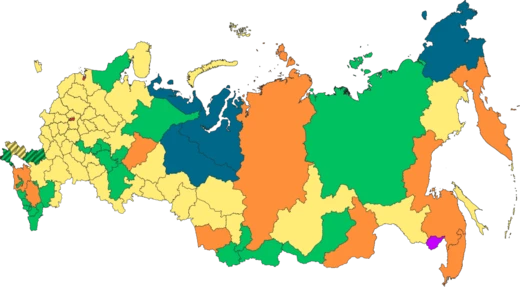
Voronezh Oblast
Federal subject of Russia with rich archaeology and agriculture.

Voronezh Oblast is a federal subject of Russia (an oblast) located in the center of the European part of Russia. Its administrative center is the city of Voronezh, and its population was 2,308,792 as of the 2021 Census. The oblast is significant for its industrial-agrarian economy, its role as a major supplier of agricultural products, and its archaeological sites containing some of the earliest remains of anatomically modern humans in Europe.
- established
- 13 June 1934
- area
- 52,400 km²
- population
- 2,308,792 (2021 Census)
- administrative_center
- Voronezh
- major_river
- Don
- climate
- temperate continental
- average_january_temperature
- -4.5 °C
- average_july_temperature
- +25 to +30 °C
Lore & Background
Voronezh Oblast was established on 13 June 1934. On 21 May 1998, it signed a power-sharing agreement with the federal government, granting it autonomy, which was abolished on 22 February 2002. The oblast contains the Kostyonki site, known for a high concentration of cultural remains of anatomically modern humans from the beginning of the Upper Paleolithic era. A layer of Campanian volcanic ash from about 40,000 years ago has been found above some finds, indicating occupation by 'unknown humans' before that date. The earliest directly dated human remains from the site are a tibia and fibula dated to 32,600 ± 1,100 14C years, with traits classifying them to European early modern humans. In 2009, DNA was extracted from a male hunter-gatherer who lived 40,000 years BP, with maternal lineage U2, buried in an oval pit in a crouched position and covered with red ochre.
Reader's Guide
Voronezh Oblast holds significance as a key industrial and agricultural region in Russia. Its economy is dominated by mechanical engineering, power systems engineering, and food processing, with major companies including Sozvezdie, Molvest, Voronezhsintezkauchuk, and the Russian branch of COFCO Group. The oblast is a leading producer of sugar beets, sunflower, and potatoes, and in 2014 ranked first in Russia for gross harvest of potatoes. Its archaeological importance is underscored by the Kostyonki site, which provides some of the earliest evidence of anatomically modern humans in Europe, including DNA from a 40,000-year-old hunter-gatherer. The oblast's demographic trends show a declining population and a low total fertility rate of 1.21 children per woman in 2024. Religiously, a 2012 survey found 62% of the population adheres to the Russian Orthodox Church, with 21.5% identifying as spiritual but not religious.
Did You Know?
- Voronezh Oblast contains the Kostyonki site, which has yielded human remains dated to 32,600 ± 1,100 14C years.
- The oblast's main river, the Don, flows 530 of its 1,870 km through the area.
- In 2014, Voronezh Oblast ranked first in Russia for gross harvest of potatoes, collecting 1.757 million tons.
- The oblast signed a power-sharing agreement with the federal government on 21 May 1998, which was abolished on 22 February 2002.
More in Russian Regions 1-24
Elsewhere in the Russian Regions universe
Spotted an error? Know more?
This is a living reference — every entry is fact-audited, and reader corrections feed straight into our audit queue. Suggest an edit · See this site's audit record